_1779606969667-ZJZA6fNi.png)
_1777949319555-DTVd6WJp.png)
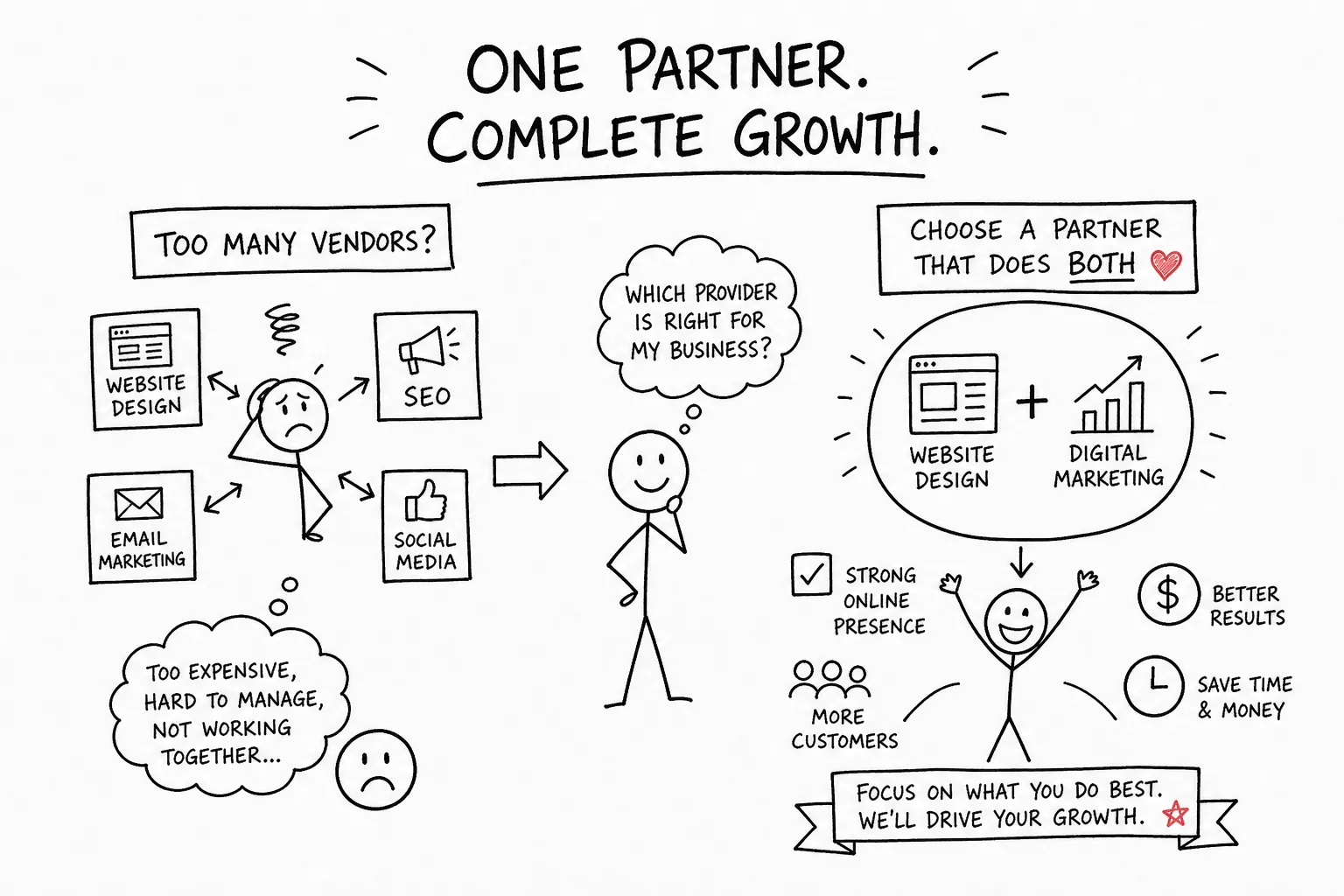
Here's a situation most NZ small business owners know well. You pay someone to build your website, then realise six months later that nobody can find it. So you hire an SEO person. Then you decide to try Google Ads and bring in a third supplier. Now you've got three invoices, three conversations, three different opinions, and nobody taking responsibility when results don't show up. If you're wondering which services handle both website design and digital marketing for small businesses, the case for finding one provider who manages the whole thing is obvious. The problem is that "full-service" varies widely between agencies and is often used without clear deliverables. Plenty of agencies list ten services on their website and do two of them well. This guide cuts through that. It covers what a genuine combined package should include, what you should pay, how to verify an agency's capability, and the questions that separate real providers from ones with impressive brochures.
What a combined website and marketing package actually includes
Website design and technical foundations
Any reputable provider should deliver a mobile-responsive site built around clear calls to action, not just one that looks good on a laptop. The core deliverables are straightforward: professional design, conversion-focused layout, managed hosting, SSL, domain support, and backups. Hosting and maintenance tend to get glossed over in the sales process, but they matter, check whether monthly hosting and maintenance fees (commonly NZ$50 to $300 per month) are included in your quote or listed as extras in the contract. A small business that can't afford a hacked site or unexpected downtime needs someone who manages the technical side as standard, not as an optional extra.
SEO, local search, and AI-search readiness
On-page SEO covers the basics: page titles, headings, URL structure, internal links, metadata, and structured data. Local SEO goes further, covering your Google Business Profile, location-targeted service pages, and directory listings that help you show up when someone searches "plumber near me" rather than just "plumber." Then there's AEO, or AI-search readiness, which means structuring your content so tools like Google's AI Overviews and ChatGPT can understand your business and surface it in answers. Not all agencies have caught up with this yet. If you're evaluating providers in 2026, it's worth asking directly whether they build with AI-search visibility in mind, because those who don't are already falling behind.
Ads and ongoing marketing support
Paid advertising, whether Google Ads or Meta Ads, typically involves two separate costs: the management fee paid to the agency and the ad spend paid directly to the platform. Make sure you understand which is which before signing anything. Ongoing support should include monthly reporting that actually explains what's happening, not just a spreadsheet of impressions and clicks. Qualified leads, conversion rate, and cost per acquisition are the primary commercial measures that should be tracked through proper conversion tracking in GA4 and Tag Manager. If an agency can't tell you how many qualified leads their work generated last month, find a different agency. That number is the one that matters.
Which services handle both website design and digital marketing for small businesses?
Large full-service digital agencies
Large agencies have the capability, but the question for a small business is whether you'll get their best people or their most junior ones. Big agencies often take on small business clients at a lower tier, which means your account might be handled by someone who's still learning the ropes while the senior team works on enterprise clients. The capability is real. The attention you'll receive is worth questioning before you commit.
Boutique NZ agencies built for small business
This is where the practical sweet spot sits for most NZ small businesses. Boutique agencies that specialise in SMEs tend to offer integrated website and SEO services, transparent pricing, and teams that understand how local NZ markets actually work. Fairweb, for example, is built around this model, website design, managed hosting, on-page and local SEO, AEO readiness, and ads support. All of this comes under fixed-price quotes with plain-language reporting each month. There's no guessing what you're paying for, and the team working on your account understands the difference between ranking in Auckland and ranking nationally. Agencies built for small business budgets are designed for this kind of work. Agencies built for enterprise clients are not.
Freelancers and platform-based services
If your budget is genuinely tight, a freelancer or a website builder with marketing bolt-ons can be a reasonable starting point. The limitation is coordination: design and marketing remain separate disciplines even if you're trying to manage them through one person or one tool. You often end up with a site that wasn't built with SEO in mind, and retrofitting that is harder and more expensive than doing it right the first time.
Bundled vs separate suppliers: the real trade-offs
Why a single provider tends to work better for most small businesses
When the same team builds your site and runs your ads, they know exactly where traffic lands and what happens when it gets there. There's no blame game between your web designer and your SEO person. Design and SEO are planned together from the start, which means your site structure, page content, and keyword strategy are aligned rather than bolted together after the fact. For a small business running lean, that coordination isn't a nice-to-have. It's the difference between a marketing system that works as a whole and three services that each performs adequately in isolation.
When separate specialists make more sense
Separate specialists can work well in specific situations. If you already have a strong, well-built website and only need ads management, there's no reason to change everything. If your budget is large enough to hire a top-tier specialist for each discipline and you have someone in-house to coordinate them, the depth of expertise can be worth it. For most NZ small businesses, though, the coordination overhead is a real cost. When something isn't working, every supplier has an incentive to point at the other one. That friction takes time and energy to manage, and most small business owners don't have either to spare.
What NZ small businesses should expect to pay
Typical NZ pricing ranges by package level
The numbers vary depending on scope and provider, but here's a realistic picture for 2026. Lean starter packages typically run NZ$1,500 to $4,000 for the website build and NZ$500 to $1,500 per month for ongoing marketing. Standard small business packages sit around NZ$4,000 to $9,000 for the build and NZ$1,500 to $4,000 per month for a multi-channel marketing retainer. Growth-focused packages go above that. A practical planning figure for many local NZ businesses is NZ$5,000 to $9,000 for the initial site, plus NZ$1,500 to $3,000 per month for marketing. These ranges are approximate and drawn from current NZ market rates. Advertising spend is almost always additional, typically NZ$500 to $2,000 per month paid directly to the platform. GST may or may not be included in advertised prices, so check before you compare quotes.
Common contract structures and what to watch for
The most common arrangement is a fixed website project followed by a monthly marketing retainer. A three-month pilot is a reasonable starting point; six to twelve month terms are standard for ongoing work. Watch out for vague "unlimited support" language. It almost never means what it sounds like. More importantly, confirm in writing who owns your domain, your website files, your Google Analytics property, and your advertising accounts. Some agencies retain control of these assets as a form of lock-in. If a contract doesn't clearly state what happens to access and ownership when you leave, that's a problem to resolve before you sign, not after. Fixed-price agreements with itemised scope are far easier to evaluate and compare than hourly or blended-rate proposals where the final cost is anyone's guess.
How to verify an agency actually delivers on both
Credentials, case studies, and live examples to request
Ask for two or three case studies showing comparable NZ businesses, with before-and-after metrics that include baselines, timeframes, and real business outcomes, not just traffic graphs and follower counts. The numbers that matter are qualified leads, conversion rate, and cost per acquisition. An agency that only shows you impressions and rankings tracks the wrong things. That matters. Request live website URLs and test them yourself using PageSpeed Insights. Ask whether you can speak directly with current clients, not just former ones. A willingness to make that introduction is a stronger signal than any published testimonial.
Ownership and account access: a non-negotiable
Your domain, your website, your analytics, your ad accounts. These should be yours from day one, with no exceptions. Ask any prospective agency directly: what happens to access and ownership if this relationship ends? A reputable agency will give you a clear, simple answer. If the answer is vague, evasive, or buried in contract language that requires a lawyer to interpret, treat that as a serious warning sign. The ability to walk away cleanly, with everything that's yours, should never be a negotiating point.
Questions to ask any agency claiming to handle both
Strategy and capability questions
The questions that separate a capable agency from a capable-looking one are straightforward. When evaluating any provider that offers end-to-end digital services for small businesses, you want to know which services they perform in-house and which are outsourced. Find out what their strongest capability is and whether they can show a result for a business like yours. Confirm who will actually work on your account day to day and how many other accounts those people manage. Ask what their onboarding process looks like and what they'll need from you. Request an example monthly report from a comparable engagement. The answers tell you whether this is a team with genuine integrated capability or a single person with a broad services page and a few trusted subcontractors.
Measurement and accountability questions
These are the questions that test whether the agency connects its work to real business outcomes rather than activity metrics. Ask what KPIs they'll track and how those are tied to leads or revenue, not just traffic. Ask who owns the analytics account, advertising accounts, and domain if you part ways. Ask about contract length, notice period, and what happens if performance targets are missed consistently. The most useful question of all is this one: what would you recommend we do first, what would you hold off on, and how will we know within 90 days whether it's working? A strong agency gives you a specific, evidence-based answer. A weak one gives you a services overview and a proposal that could belong to any client.
Making the right call for your business
Most NZ small businesses benefit from a single provider that handles both website design and ongoing digital marketing, provided that provider has genuine capability across both disciplines, transparent pricing, and clear accountability. When you're weighing up which services handle both website design and digital marketing for small businesses, the warning signs are easy to spot: vague pricing, buried ownership clauses, and case studies without baselines or real business metrics. Ask the hard questions before you sign anything. If an agency can't answer them clearly and confidently, that tells you everything you need to know about how they'll communicate once you're a client. The goal isn't a long-term agency relationship for its own sake. The goal is qualified leads, real enquiries, and a website that does its job.
Fairweb offers NZ small businesses a fixed-price option covering website design, managed hosting, on-page and local SEO, AEO readiness, and ads support with plain-language reporting every month. If you want to see exactly what that looks like for your business, get in touch with the team for a straightforward conversation.
Related Service
Website Design & Development
See how Fairweb supports New Zealand small businesses with website design & development.
Learn more