_1779606969667-ZJZA6fNi.png)
_1777949319555-DTVd6WJp.png)
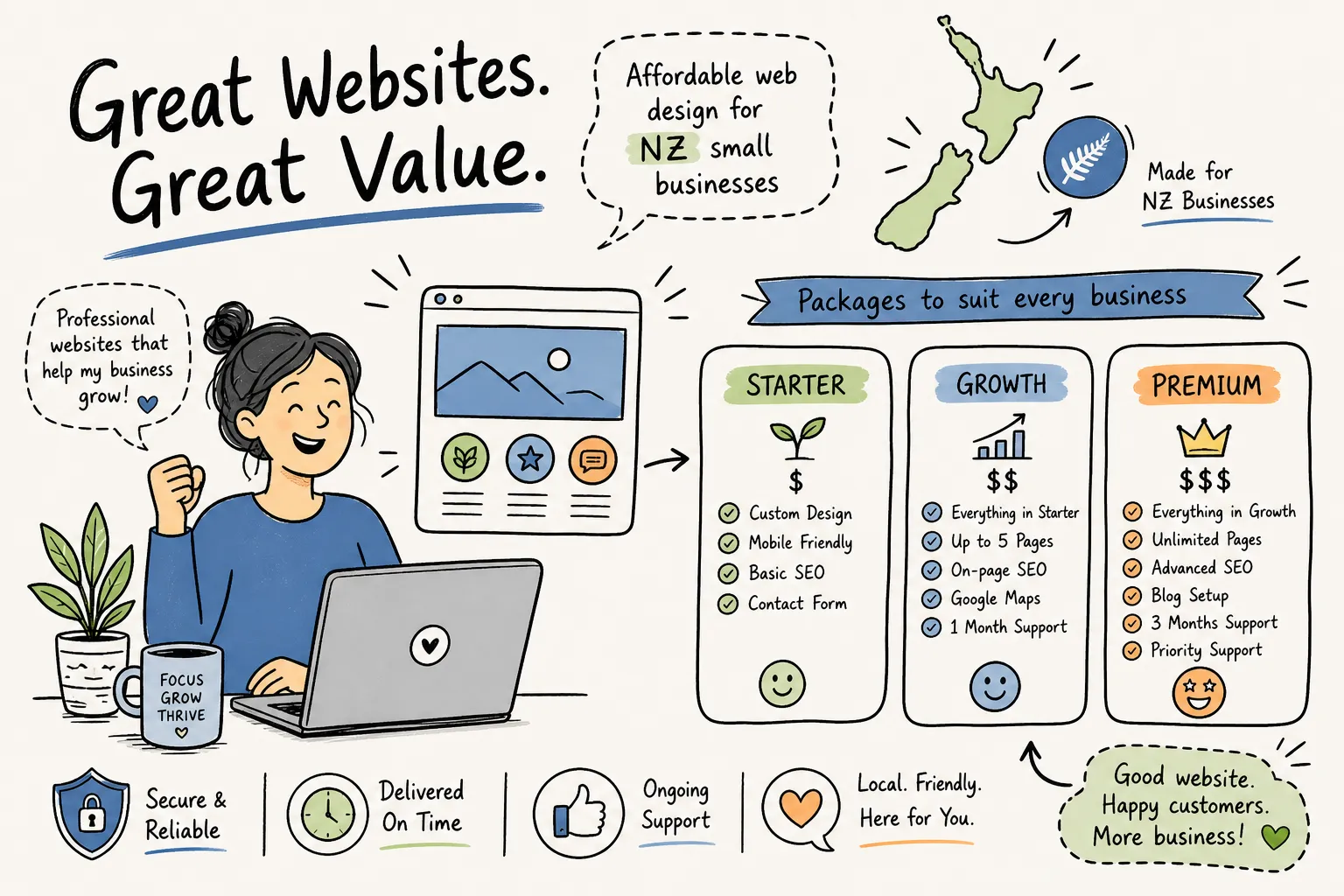
Many small business owners in New Zealand gather multiple quotes and still can't figure out why one agency charges $699 and another charges $8,000 for what looks like the same thing. Pricing is often confusing, vague scope, hidden add-ons, and jargon-heavy proposals make it nearly impossible to compare apples with apples.
This guide explains which companies offer affordable small business web design packages in NZ and what to expect from their tiers. We'll cover what those packages genuinely include, what drives costs up, and how to evaluate whether you're getting real value or just a cheap website that won't generate a single enquiry.
At Fairweb, we work with small businesses across NZ every week. The same two questions come up constantly: "What should I expect to pay?" and "How do I know if it's worth it?" This article answers both.
What these packages actually cost in NZ
Affordable web design in New Zealand spans a wider range than most people expect, and the label "affordable" means something different depending on who's using it. Here's how the market actually breaks down in 2026.
The four tiers you'll encounter are roughly these:
- Entry-level template-based sites: $350–$999. Adhesion's basic package starts at $699; Digital Candy's entry tier at $350.
- Starter small-business packages: $1,000–$2,500. Jelly Digital sits at $1,495. FernByte offers a $499 upfront setup plus $49 per month — note that the upfront cost sits below $1,000, so factor in the monthly fee when calculating total outlay over time.
- Budget custom builds from small agencies: $2,000–$5,000.
- Professional, conversion-focused builds: $5,000–$15,000, depending on page count and functionality.
One-off builds and subscriptions
For most NZ small businesses, the realistic sweet spot for a starter website package is around $600 to $1,500 for a packaged build, with custom options typically starting from $2,000 upwards. That's not the rock-bottom floor; it's where usable, professional sites live.
There's also an important distinction between pricing models. Some agencies charge a one-off setup fee; others use a subscription model with $0 upfront, such as Digital Presence at $95 per month. The subscription model lowers the entry barrier, which suits businesses with tight cash flow. Run the numbers over three to five years, though, and the total cost is often higher than a one-off build. Neither model is wrong, but you need to understand the full cost of ownership before you sign anything.
Which companies offer affordable small business web design packages in NZ
There are a handful of providers worth knowing about, and they suit different situations. Here's an honest look at the main options.
Subscription-based and ultra-budget options
Digital Presence ($95 per month, $0 upfront) focuses on single-page builds with managed hosting and basic on-page SEO included. It's a reasonable entry point for a business that needs something live quickly with minimal commitment. Digital Candy's basic and silver tiers ($350 to $600) and Adhesion's entry packages ($699 to $1,299) are similarly positioned: low cost, template-driven, limited customisation. These budget web design options for small businesses suit those with very simple needs or genuinely tight cash flow. The trade-offs are real: minimal pages, limited SEO depth, and in most cases little ongoing support once the site is live.
Fixed-price package builds from NZ agencies
Jelly Digital's $1,495 starter package delivers four to six pages, mobile-responsive design, a contact form, basic on-page SEO, and Google Analytics setup with a two-week turnaround. That's a solid offering at the price. FernByte's model ($499 setup plus $49 per month) covers five pages, SSL, basic analytics, and one small update per month. Both are credible fixed-price web design package options for small businesses that need more than a single page but don't need a fully custom build. Where they can fall short is in local SEO depth and post-launch support — both are often thin at this price point and worth asking about directly before you commit.
Why Fairweb is worth a closer look for NZ small businesses
Fairweb is built around one outcome: generating real enquiries for small businesses, not simply getting a website live. Well-scoped fixed-price quotes mean you know what you're paying before work starts, with scope and change control documented in writing to reduce the risk of surprises. Local SEO is built into every build, managed hosting is included, and the support relationship continues after launch rather than ending at handover.
Stuart Hargreaves from T&T LUX put it plainly after working with Fairweb on his starter website: the support made the process straightforward, and he expects to work with the team long-term. That kind of relationship is the difference between a website that looks good and one that actually works for your business. If you want a straight answer on what a site will cost and what it will do for your enquiry flow, reaching out to Fairweb is a logical first step.
What every decent starter package should include
Before you evaluate any quote, you need a baseline. These are the features that should be standard in any affordable small business web design package, not listed as extras once you've already committed.
Every starter package worth paying for should include:
- Responsive (mobile-friendly) design
- CMS access so you can edit your own content without calling a developer
- Basic on-page SEO covering titles, meta descriptions, and heading structure
- SSL/HTTPS security
- A contact form with clear calls to action
- Core pages: Home, About, Services, Contact
- Domain and hosting setup or clear guidance on how to arrange it
- A launch handover or basic training
Which add-ons are worth paying for
If any of these appear as paid add-ons, the package is not as affordable as the headline price suggests. Add them up and a cheap site often becomes an average-priced one very quickly.
Legitimate add-ons worth paying for, if you need them, include custom copywriting, blog setup, advanced local SEO, Google Analytics and Search Console configuration, and e-commerce or booking system integration. Ongoing monthly maintenance is also worth budgeting for separately. The add-ons that genuinely improve outcomes are local SEO and analytics; the ones that are truly optional include social media icon styling and premium stock photo libraries. Know the difference before you compare quotes.
How to compare companies offering affordable web design packages
Price tells you almost nothing about whether a website will work for your business. Two sites can cost the same and perform very differently. Here's what actually determines value.
Conversion-focused design vs. a pretty brochure
A website that generates enquiries does specific things: it communicates your core service clearly above the fold, it shows trust signals like testimonials and local credentials, and every page has a strong call to action. A $999 template site missing these elements may well underperform a $2,500 custom build that gets the structure right, with the measurable difference showing up in enquiry rates and lead volume. The question isn't what the site looks like; it's what it makes visitors do. Ask any provider you're considering to explain how their build approach drives enquiries, not just traffic.
Local SEO and managed hosting as value multipliers
Local SEO goes beyond basic on-page optimisation. It covers Google Business Profile alignment, suburb and service-area keywords, consistent business name, address, and phone details across the web, and structured content that helps Google understand who you are and where you operate. Most entry-level packages skip this entirely or treat it as an expensive add-on. For a service business in Auckland, Christchurch, Hamilton, or anywhere else in NZ, local SEO is not optional — it's how you get found by customers who are actually nearby and ready to hire.
Managed hosting matters for similar reasons. There's a significant difference between an agency that handles security patches, plugin updates, and backups on your behalf, and one that simply hands over login credentials and wishes you luck. Broken plugins, expired SSL certificates, and outdated software don't just look bad — they actively hurt your search rankings and can expose your site to security risks. Fairweb includes both local SEO and managed hosting as standard. At this price point, that's uncommon and worth factoring into your comparison.
Red flags that tell you to walk away
Not every provider offering low-cost small business web development is a good one. These warning signs are worth knowing before you hand over a deposit.
Pricing that's vague or quote-on-application only
An agency that won't give you a clear price upfront is usually one whose final invoice will surprise you. "From $X" language with no detail on page count, inclusions, or scope means you can't compare fairly with other providers. Fixed-price, itemised quotes are the baseline you should expect from any reputable provider. If a provider can't commit to a defined scope in writing before you sign, that's not a negotiating style — it's a warning sign about how the entire project will be managed.
No support plan after your site launches
Ask this question before you commit: "What happens if something breaks six months after launch?" Ask also: "Do you offer ongoing support, and at what cost?" A provider that can't answer those questions clearly is not set up for a long-term relationship with your business. Many cheap packages follow a predictable pattern: the agency delivers the site, disappears, and the business owner is left managing broken links, outdated plugins, and expired SSL certificates with no one to call. Cheap upfront can mean expensive later, particularly when a full rebuild becomes the only solution.
A simple checklist before you request quotes
Use this list when comparing providers. If a quote doesn't address these points, ask directly before signing anything.
- Does the package include mobile-responsive design as standard?
- Is local SEO (not just "basic SEO") part of the build?
- Is hosting managed by the agency, or do you handle it yourself?
- Is the price fixed, with scope defined in writing?
- What pages and features are included versus charged as extras?
- Is there a support plan after launch, and what does it cover?
- Can they show a portfolio example or client testimonial from a similar NZ business?
Request quotes
Request quotes from two or three providers using this list. If a provider can't answer every item clearly, that tells you something useful before any money changes hands. Fairweb offers transparent, fixed-price quotes with local SEO, managed hosting, and ongoing support built in as standard. Get in touch with our team and we'll give you a straight answer on what a website will cost and what it should do for your business.
The bottom line
Affordable web design options for NZ small businesses exist across a wide price range, but price alone tells you almost nothing about what you'll actually get. What matters is whether the package is built to generate real enquiries, includes local SEO and managed hosting, and comes from a provider who'll still be answering your calls six months after launch.
Use the checklist, ask the right questions, and compare on value rather than headline cost. The cheapest option rarely turns out to be the most affordable once you account for what's missing and what eventually needs rebuilding. The best-value small business web design package is the one that works from day one, and keeps working.
Frequently Asked Questions
Which companies offer affordable small business web design packages in NZ?
Several NZ providers offer fixed-price or subscription-based packages for small businesses. Entry-level options include Digital Candy (from $350), Adhesion (from $699), and Digital Presence ($95/month with no upfront cost). Mid-range starter packages come from providers like Jelly Digital ($1,495) and FernByte ($499 setup plus $49/month). Fairweb offers fixed-price builds with local SEO and managed hosting included as standard, suited to businesses that want a site built to generate enquiries rather than just appear online.
What is typically included in a starter web design package?
A decent starter website package for SMEs should include mobile-responsive design, CMS access, basic on-page SEO, SSL security, a contact form, core pages (Home, About, Services, Contact), and domain and hosting setup. If any of these are listed as paid extras, the true cost is higher than the headline price suggests.
Is a subscription model or a one-off build better value?
It depends on your cash flow and how long you plan to use the site. Subscription models (such as $0 upfront, $95/month) lower the entry barrier but often cost more over three to five years than a single fixed-price build. Run the full-term numbers before you decide.
How much should a small business expect to pay for a professional website in NZ?
Most small businesses will find suitable packaged builds between about $600 and $1,500. Custom small-business sites typically start from $2,000, with conversion-focused professional builds ranging from $5,000 to $15,000 depending on scope and functionality.
Related Service
Website Design & Development
See how Fairweb supports New Zealand small businesses with website design & development.
Learn more