_1779606969667-ZJZA6fNi.png)
_1777949319555-DTVd6WJp.png)
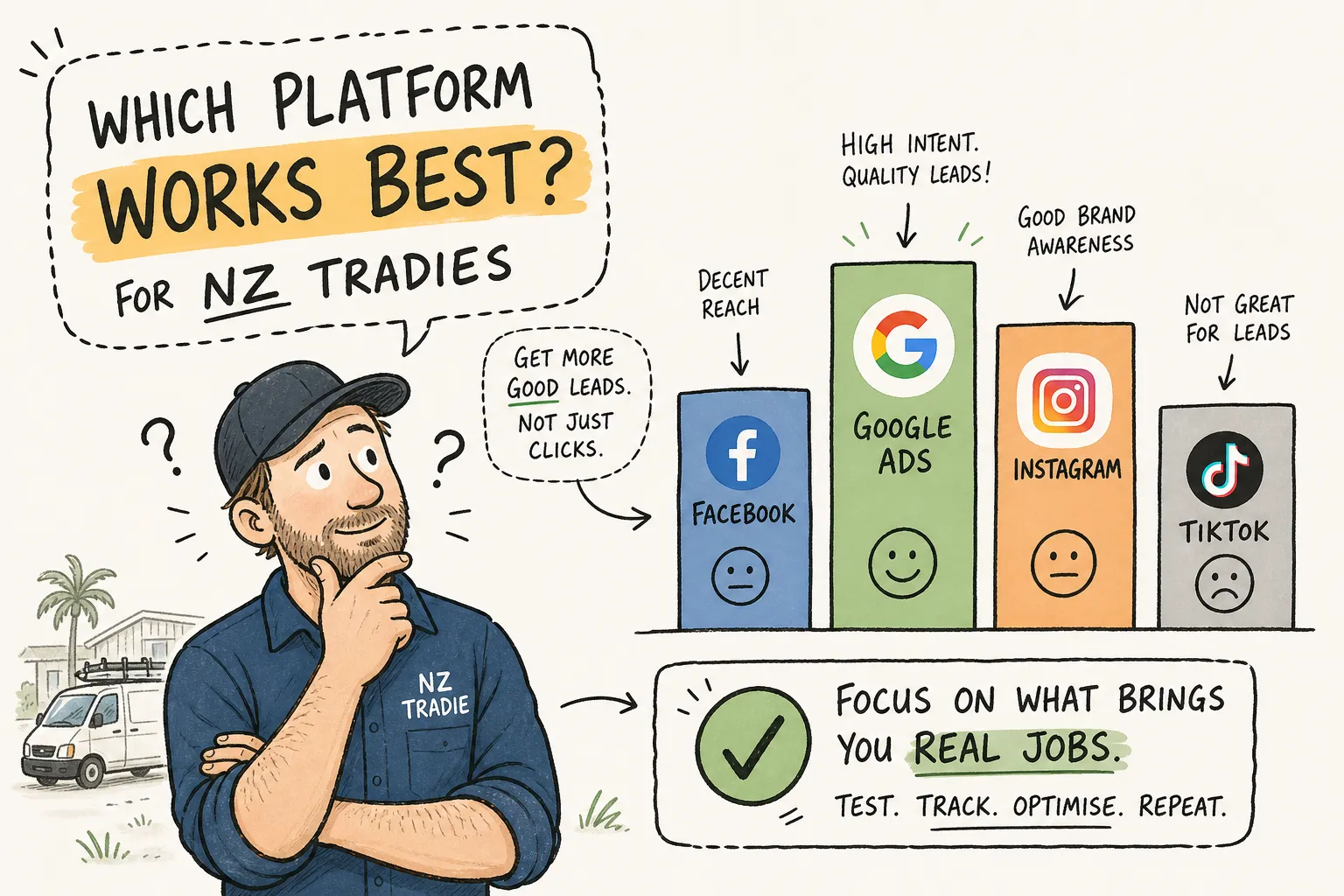
If you are asking which advertising platform works best for NZ tradespeople, you are not alone, and the answer is not as simple as “Google” or “Facebook.” Many NZ tradies report spending money on ads that never ring the phone, or avoiding paid advertising altogether because a previous campaign burned them.
The problem is rarely the budget. A far more common cause of poor performance is platform–trade mismatch: choosing the wrong channel for how your customers actually buy. At Fairweb, we manage both Google and Meta campaigns for NZ trades businesses, and the same question comes up constantly: “Which one should I be on?” The honest answer depends on what you do, where you work, and how your customers make decisions. This article gives you the practical breakdown, real cost benchmarks, and a simple testing plan so you can stop guessing.
The one question that tells you where to start
There is a fundamental difference between a homeowner who types “emergency plumber Wellington” into Google and someone scrolling Facebook who sees a beautifully finished deck renovation. One has a problem right now. The other is dreaming about a future project. The platform you choose should match which type of customer you need.
Google Ads captures people at the exact moment they are ready to hire. Meta Ads interrupts people before they have even started thinking about it. Neither is better in absolute terms — they solve different problems.
Ask yourself this: do people hire you because something broke, or because they are planning something? Urgent, unplanned jobs — burst pipes, failed fuse boards, roof leaks — come from high-intent search behaviour, and Google wins there. Planned, visual, aspirational projects like new kitchens, landscaped gardens, and house extensions come from people browsing and saving ideas, and Meta wins there. Most tradies already know intuitively which camp they sit in. The data just confirms it. For a deeper comparison, see our guide to Google Ads vs Meta Ads for small businesses.
Google Ads for urgent trades
When someone searches “electrician near me” in Christchurch, they are not comparing options leisurely. They want a response today. That urgency drives higher conversion rates. For home services trades in NZ, Google Search Ads regularly convert at 12 to 16 percent for emergency-type jobs, meaning roughly one in eight people who click your ad ends up enquiring, based on home services benchmarks tracked across NZ campaigns.
The average click-through rate for Google Ads in New Zealand sits at 8.64 percent, noticeably above the global average of 6.42 percent. For NZ home services, expect to pay roughly NZ$3 to NZ$6+ per click on competitive trade search terms, with cost per lead typically landing somewhere between NZ$70 and NZ$145 — though your specific trade, service area, and landing page quality will all influence where you land. These figures are directional benchmarks; your results will vary.
For trades with high average job values — electrical upgrades, drainage work, roof repairs — those lead costs compare favourably against the revenue each job brings in. To make it concrete: a plumber booking one job per week from a Google campaign costing NZ$500 per month, with an average job value of NZ$600 to NZ$800, is running a highly profitable channel even at the upper end of that cost-per-lead range. Once you know your average job value, the maths becomes straightforward. This is PPC for tradies at its most effective: high intent, measurable cost, direct return.
Why Meta ads make more sense for builders and landscapers
If your best marketing asset is a before-and-after photo of a finished garden or a renovated bathroom, Facebook and Instagram give you a canvas that Google cannot. Homeowners planning a major project spend weeks browsing inspiration online before they ever search for a specific business. Meta Ads let you get in front of that audience early and stay visible while they are still deciding.
Social media advertising for tradies is often where the best leads originate. Meta ads for trades in NZ can produce leads for NZ$15 to NZ$35 each based on reported NZ campaign examples, with strong campaigns occasionally going below NZ$20. Conversion rates on Meta lead forms for home improvement services benchmark around 6 to 7 percent, though the quality of your creative and your offer matters enormously.
One important caveat: Meta leads are softer — less committed at the point of contact than someone who has actively searched for you. Expect a longer nurture process before they book. To give campaigns enough data to perform, budget at least NZ$30 per day as an absolute minimum, though NZ$50 per day will reach the learning threshold more reliably. Follow up promptly; delays of more than a few hours significantly reduce the likelihood of converting a Meta lead into a booked job.
The honest verdict on Bing and trade marketplaces
Bing has a niche audience in NZ, often skewing older with slightly higher household incomes. Conversion rates can be reasonable, but the raw volume of searches is too low to drive meaningful lead flow for most trades. It is worth a small test budget if you have exhausted Google’s capacity in your area, but it should never come before getting Google right first.
Platforms like Oneflare and Hipages operate on a shared-lead model: the same lead gets sent to multiple tradies and you compete on price and speed. Anecdotally, that dynamic tends to erode margins, and public NZ conversion and cost-per-lead data for these marketplaces is limited, so it is difficult to benchmark them against owned channels. They can fill gaps in a quiet month, but they are not a foundation. When you own your Google or Meta presence, the lead belongs to you. The homeowner found you, not a marketplace. That changes the entire conversation from the first contact.
A 30/60/90-day testing plan
Pick the platform that matches your trade type based on what you have read above. Set a realistic daily budget — NZ$20 to NZ$50 per day is enough to gather data on Google; NZ$30 to NZ$50 per day for Meta, though the higher end will accelerate the learning phase. Write one strong ad, point it to a dedicated landing page rather than just your homepage, and track every enquiry.
Do not try to run Google and Meta simultaneously in month one. Split focus means split data and split conclusions. After the first month, you should have enough to see your cost per enquiry, how many of those enquiries became booked jobs, and what your return on ad spend looks like.
If the numbers stack up, increase the daily budget incrementally — 20 to 30 percent at a time rather than all at once. If results are poor, audit the landing page before you blame the platform. Most underperforming campaigns fail at the conversion step, not the click step. A weak headline, a phone number buried at the bottom of the page, or a form with too many fields will kill an otherwise solid campaign. This is exactly why it is worth checking whether your website is ready for ads before you spend a dollar.
- Days 1 to 30: One platform, one goal, one landing page. Track every enquiry.
- Days 31 to 60: Review cost per enquiry and lead-to-job conversion. Fix the landing page if needed before increasing spend.
- Days 61 to 90: Scale what is working by 20 to 30 percent. Decide whether the second platform is warranted.
One channel done well beats three done poorly
The temptation is to be everywhere. Resist it. A single well-managed Google Ads campaign with a converting landing page and consistent follow-up will outperform a scattered three-platform approach every time. Spreading a NZ$1,500 monthly budget across Google, Meta, and Bing means none of them gets enough data to optimise properly. Concentrate that same budget on one platform and you will see results far sooner.
Once your primary channel is profitable and running consistently, that is the right time to add a secondary one — not before. The business owners who get the best results from paid advertising are not the ones who are everywhere simultaneously. They are the ones who picked one thing, got good at it, and then expanded from a position of confidence.
If you do not want to manage campaigns yourself — and most tradies do not — the right agency should be able to tell you clearly which platform suits your trade in your service area, what budget makes sense, and what results to expect within 60 to 90 days. At Fairweb, we work specifically with NZ small businesses and trades, managing both Google Ads and Meta campaigns through our social media and ads management service. We help you pick the right starting point based on your trade, your location, and your budget, then build campaigns around what actually generates booked jobs.
Plumbers and electricians: start with Google. Builders and landscapers: start with Meta. The reason comes down to one thing — where your customers are in the buying process when they first encounter your ad. Match the platform to that moment and you are already ahead of most.
Stop paying for platforms that do not match how your customers buy. Pick one, commit for 90 days, and let the data tell you what to do next. If you want a second set of eyes on your current ad strategy, or you are starting from scratch and want to get it right the first time, get in touch with Fairweb for a no-obligation review — no jargon, just a straight conversation about what is likely to work for your trade and your area.
Frequently Asked Questions
Should NZ tradies use Google Ads or Facebook ads?
It depends on your trade. Plumbers, electricians, and other urgent or emergency trades usually do best on Google Ads, where customers search at the moment they need help. Builders, landscapers, and renovation trades often do better on Meta (Facebook and Instagram), where visual before-and-after work reaches people planning future projects.
How much do Google Ads cost for NZ trades businesses?
For NZ home services, expect roughly NZ$3 to NZ$6+ per click on competitive trade terms, with cost per lead typically between NZ$70 and NZ$145. Your trade, service area, and landing page quality all affect where you land. These are directional benchmarks — your actual results will vary.
How much should I budget for Meta ads?
Budget at least NZ$30 per day as a minimum so the campaign can gather enough data, though NZ$50 per day reaches the learning threshold more reliably. Meta leads are often cheaper (NZ$15 to NZ$35 each) but softer, so prompt follow-up is essential.
Should I run Google and Meta ads at the same time?
Not in your first month. Running both at once splits your budget and your data, making it harder to learn what works. Start with the one platform that matches your trade, prove it over 60 to 90 days, then add the second channel from a position of confidence.
Can Fairweb manage ad campaigns for my trades business?
Yes. Fairweb manages both Google Ads and Meta campaigns for NZ small businesses and trades. We help you choose the right platform for your trade, location, and budget, then build campaigns focused on generating booked jobs rather than just clicks.
Related Service
Social Media & Ads Management
See how Fairweb supports New Zealand small businesses with social media & ads management.
Learn more