_1779606969667-ZJZA6fNi.png)
_1777949319555-DTVd6WJp.png)
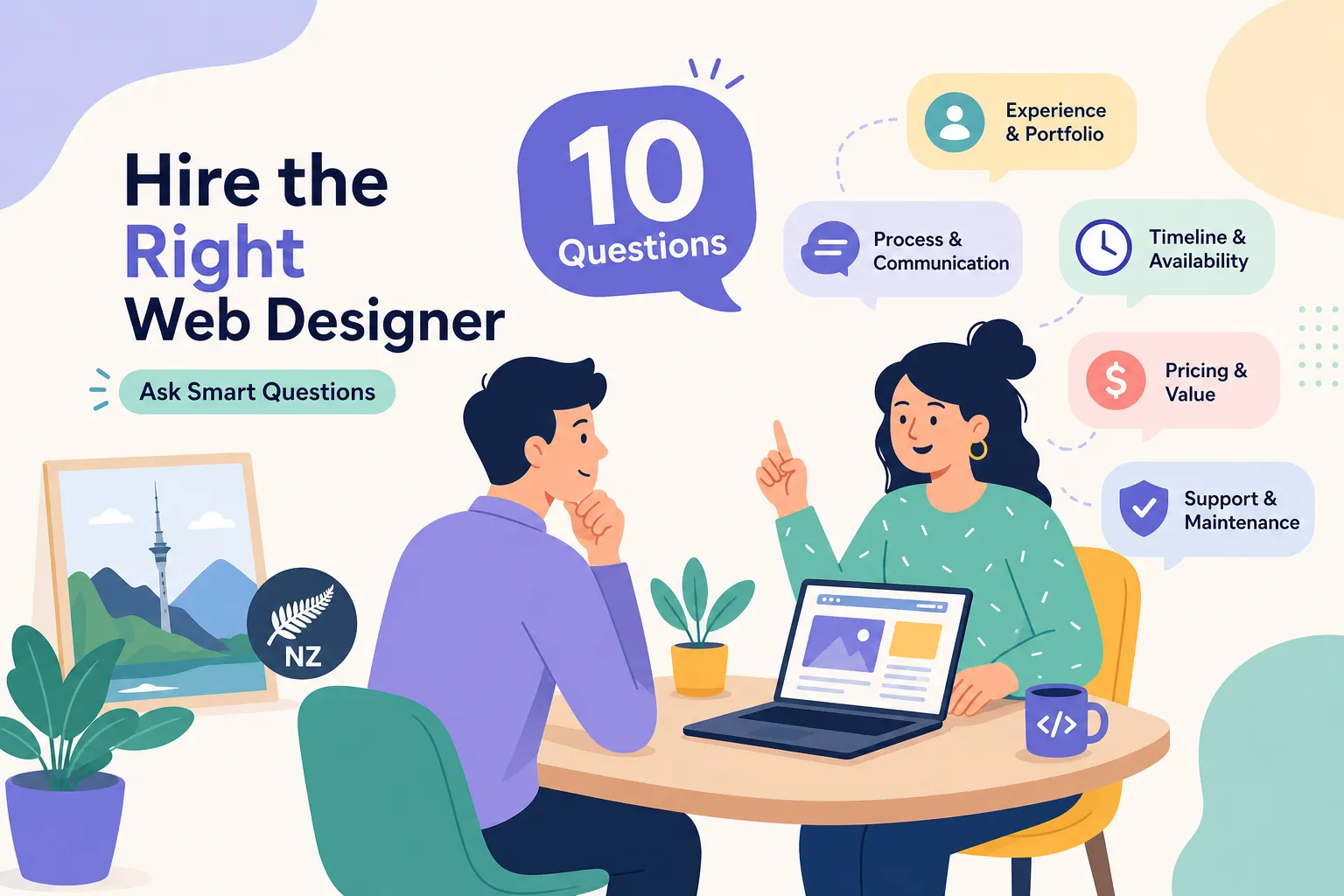
If you're wondering what questions you should ask a web designer before hiring them in New Zealand, you're already ahead of most small business owners. The usual approach is to look at past work, have a good chat, and go with whoever feels right. That's not a bad instinct, but it leaves a lot unspoken — and what doesn't get said before the contract is signed tends to become a problem six months after the site goes live.
The hiring conversation is a two-way interview. The designer is assessing whether you'd be a good client; you should be assessing whether they'd be a trustworthy partner. The right questions, asked before a single dollar changes hands, protect your budget, your brand assets, and your long-term independence. They also signal that you're an informed client, which in practice tends to produce better outcomes for everyone.
Below are 10 questions structured across five areas — pricing, platforms, ownership, timelines, and post-launch. Use them as a website design checklist when you're comparing proposals in New Zealand. Good agencies welcome every one of these questions and answer them clearly upfront, which on its own tells you something useful about how they operate.
Why most people hire the wrong designer
Many NZ small business owners discover hidden costs, unclear ownership, or zero post-launch support only after the build is complete. Not every designer is a bad actor — in most cases it's simply a lack of clear expectations on both sides. The gap between "we build websites" and "we build websites that generate enquiries for your business" is significant, and it rarely shows up in a portfolio.
A portfolio tells you what a designer can produce visually. It doesn't tell you how they communicate when a project runs late, whether their quotes include GST, or what happens to your code once you've paid. Two agencies can show equally polished work while operating with completely different standards around contracts, transparency, and client support.
Most initial quotes cover design and build only. Hosting fees, platform licensing, copywriting, content migration, SEO setup, and ongoing maintenance are often separate line items that appear later — or not at all until you ask. This isn't always deliberate, but knowing what to ask changes the dynamic entirely.
1. What does the quoted price include, and what costs extra?
A complete quote should cover design, development, content layout, stock images, revision rounds, domain setup, SSL certificate, and GST. For most service-based businesses in NZ, a professional website build sits between $4,000 and $15,000 depending on scope and complexity. What inflates cost quickly is custom functionality, e-commerce, or content creation.
Ask for a line-item breakdown, and specifically confirm whether copywriting, photography, and ongoing hosting are included or billed separately. For an illustrated breakdown of typical build costs, see our guide on how much a website costs in NZ.
2. What platform will you build on, and can I update it myself?
The most common platforms used by NZ designers are WordPress, Shopify, and Webflow, each with different trade-offs. WordPress offers flexibility and strong SEO capability but needs some technical upkeep. Shopify suits e-commerce well but carries monthly platform fees. Webflow delivers strong design control but can be complex for non-technical users.
The key question is whether you can make basic updates yourself without going back to the agency each time. Platform choice directly affects your long-term running costs and how easily you can switch providers down the track — it's one of the most important, and most overlooked, things to confirm before you commit.
3. What are the ongoing costs after the site goes live?
The build price is a one-off; the ongoing costs are what you'll carry for years. Ask specifically about hosting fees, domain renewal, plugin licences, and maintenance retainers. Reputable NZ agencies are transparent about these from the outset.
Most ongoing maintenance and support packages sit between $200 and $500 per month and cover security updates, backups, and minor content changes. If an agency is vague about post-launch costs during the quoting stage, that's worth noting.
4. Who owns the website, code, and design after I pay?
This is the area most clients overlook entirely, and it's where things get complicated later. Under the Copyright Act 1994 in New Zealand, copyright belongs to the creator by default — not the client — unless the contract explicitly transfers ownership. Most small business owners don't know this, and most standard quotes don't mention it.
Without a written copyright assignment clause, you receive a licence to use the work, not ownership of the underlying code or design files. That matters if you ever want to move to a different agency, sell the business, or modify the site independently. Ask to see the assignment clause before signing — a proper contract explicitly transfers all copyright in the code, design, and content to you upon final payment. If a designer hesitates to include this, ask why.
5. Is the domain registered in my name?
Domain ownership is separate from website ownership, and it's surprisingly common for agencies to register a client's domain under their own account. That creates unnecessary dependency.
Your domain should be registered directly in your name, with full access to DNS settings, hosting credentials, and your content management system login. Ask the agency to confirm this in writing, and ask what the handover process looks like if the relationship ever ends.
6. How long will the build take, and what are the key milestones?
A professional agency should be able to walk you through the full project arc before work begins. Most small-to-medium website builds in NZ take between four and twelve weeks, depending on scope, content availability, and revision rounds. Vague timelines with no milestones are a red flag.
A structured project typically runs through discovery, wireframing, design, build, testing, and launch, with client review at defined points. Most NZ agencies structure payments around these milestones — commonly 50% upfront, 25% at design sign-off, and 25% at launch. Milestone-based payments protect both parties and give you clear checkpoints. If a quote comes with a flat payment and no schedule, ask for one.
7. Can you show me examples of NZ websites you've built for businesses like mine?
This is more than a portfolio question. The goal is to find out whether the designer understands the enquiry-driven goals of a local service business, not just visual aesthetics. A stunning portfolio of hospitality and lifestyle brands tells you very little if you're a plumber or a physio who needs people to call.
Relevant examples from your industry — trades, professional services, or health — reveal whether the designer knows how to build for conversion rather than compliments. You can see how we approach this on our portfolio page.
8. Does SEO come standard, or is it an add-on?
There's a difference between basic on-page SEO foundations and ongoing SEO as a managed service. The foundations should come standard: page titles, meta descriptions, heading structure, image alt text, mobile responsiveness, page speed, and clean URL structure. These aren't optional extras — they're what makes your site findable in the first place.
A well-built site includes SEO from day one, not as a retrofit. At Fairweb, local SEO foundations are built into every website as standard, because a site Google can't read won't generate enquiries regardless of how it looks.
9. What support do I get after the site goes live?
Industry norms in NZ typically include 30 to 90 days of post-launch support for bugs, minor changes, and technical issues, followed by an optional maintenance retainer. Ask what's covered in that initial window, whether training or handover documentation is provided, and how quickly the agency responds to issues.
If the answer is "the site is done at launch," that's a gap worth addressing before signing. A website that doesn't get maintained degrades in security, performance, and search visibility faster than most business owners expect.
10. Are there lock-in contracts, and what are the exit terms?
Monthly retainers for hosting, SEO, or ads management should give you the flexibility to exit without penalty. Ask upfront how much notice is required, what you receive if you leave — files, access credentials, transfer documentation — and whether there are any fees attached to ending the relationship.
Fairweb operates without lock-in contracts on ordinary ongoing services, because the aim is to keep clients through good work, not contractual obligation. The Free Website Build offer is the exception and requires an eligible Fairweb hosting plan with a minimum 12-month commitment. It's a reasonable standard to hold any agency to.
How to compare proposals and spot red flags
Once you've spoken with two or three shortlisted agencies, these answers give you a structured basis for comparison. You're not just comparing price; you're comparing transparency, professionalism, and alignment with how your business actually works. Think of it as your web design contract checklist — one that helps you read between the lines of any proposal. If you're shortlisting locally, see our guide on how to compare web design companies in Christchurch.
A good designer answers every one of these questions directly, without jargon and without deflection. They provide a clear written contract, explain their process in plain language, and welcome follow-up questions rather than treating them as friction. That kind of transparency doesn't appear after you sign — it shows up in the first conversation.
- Quotes with no line-item breakdown, or GST left unclear.
- Reluctance to confirm who owns the code, design files, or domain.
- Timelines with no milestones or review checkpoints.
- Evasiveness around what SEO is and isn't included.
- No clear plan for post-launch support or maintenance.
- Domains registered under the agency's account, or work quietly outsourced offshore.
When you're deciding who to hire, come back to the core question: what should I ask a web designer before hiring them in New Zealand? Use this checklist to compare answers across every agency you speak with — for more detail on selecting a partner, read our guide on how to choose a web design company in NZ.
If you'd like to put these questions to Fairweb and see what straight answers look like in practice, book a no-obligation chat or grab a free website review. We'll bring the answers.
Frequently Asked Questions
What should a quoted price from a web designer in New Zealand include?
A complete quote should list design, development, content layout, stock images, revision rounds, domain setup, SSL certificate, and GST. Ask for a line-item breakdown and specifically confirm whether copywriting, photography, and ongoing hosting are included or billed separately.
How much does a professional website build typically cost in NZ?
For most service-based businesses in NZ, a professional website build sits between $4,000 and $15,000 depending on scope and complexity. Costs rise quickly with custom functionality, e-commerce, or if you need content creation included.
Which platform should I choose: WordPress, Shopify, or Webflow?
Each platform has trade-offs: WordPress offers flexibility and strong SEO but needs technical upkeep, Shopify suits e-commerce but has monthly platform fees, and Webflow gives strong design control but can be complex for non-technical users. The key question to ask is whether you can update the site yourself and what ongoing platform costs or maintenance are required.
Who owns the website code, design files, and content after the project is finished?
Clarify ownership and licensing in the contract, including code, design files, themes/plugins, and content rights. Ask whether the developer will provide exports or transfer access for the domain and hosting so you retain long-term independence.
What common hidden costs should I watch out for that might not be in the initial quote?
Hidden costs often include hosting fees, platform licensing, copywriting, content migration, SEO setup, and ongoing maintenance. Many agencies initially quote only for design and build, so ask explicitly about these items up front.
What post-launch support should I expect and how do I check it?
Ask the designer about maintenance services, update and backup schedules, response times for fixes, and ongoing support fees. Some businesses discover zero post-launch support only after launch, so get these terms in writing before you sign.
How can I tell if a designer or agency is a trustworthy partner?
A trustworthy designer answers these practical questions clearly and provides transparent contracts and line-item quotes. Agencies like Fairweb welcome such questions up front, and that openness is a useful indicator of how they operate.
Related Service
Website Design & Development
See how Fairweb supports New Zealand small businesses with website design & development.
Learn more